U.S. Drug Enforcement Administration
The Power of the DogThe U.S. Drug Enforcement Administration is the principal American drug-enforcement agency in the novel’s widening conflict with the Mexican cartels, but its reach extends well beyond arrests and seizures. It coordinates investigations across agencies, cultivates intelligence sources, and applies pressure that reshapes the international cocaine trade. At the same time, its work is entangled with political priorities, secret operations, and Art Keller’s personal vendetta, making the agency both an instrument of enforcement and part of a larger contest over power.
Mandate and Political Setting
The agency operates within an American government that can marshal substantial resources against trafficking, yet the book repeatedly shows how the language and funding of the War on Drugs intersect with other national aims. John Hobbs frames Nicaragua as a strategic threat, arguing that a Soviet-aligned government in Central America could endanger the United States and that American intervention is necessary. He insists that Cerberus comes from the highest authority in the country. This is a covert-action argument, not a description of a DEA operation; its relevance is the political setting in which drug enforcement and anti-communist policy can provide overlapping rationales for American action.
That overlap is especially visible in plans to support the Mexican government. Hobbs sees the Zapatista Movement and the Popular Revolutionary Army as potential parts of a spreading insurgency, intensified by economic disruption. He reasons that Congress and Mexico would not openly accept a military package for counterinsurgency, but that equipment funded to fight drug traffickers could be quietly transferred to the Mexican Army for use against insurgents. The episode presents anti-drug assistance as a politically acceptable channel for a broader security policy. It does not make the DEA the author of that policy, but places the agency’s mission inside a system where the stated purpose of aid can differ from its intended use.
Enforcement and Interagency Reach
The agency’s organizational scale is made explicit through Art Keller’s later appointment as head of the Southwest Border Task Force. Based in San Diego, he leads a coordinating group in which the DEA, Federal Bureau of Investigation, Border Patrol, U.S. Customs, immigration services, and local and state police report to him. The position gives him a broad operational reach and the authority he had demanded from John Hobbs. Keller also sits on the Vertical Committee with Hobbs, a small body meant to coordinate DEA and Central Intelligence Agency activity in the Americas. Its stated purpose is to prevent agencies from interfering with one another; its unstated function is to keep Keller from obstructing the Central Intelligence Agency’s agenda. The arrangement captures both the agency’s growing coordination role and the limits imposed on it by covert political priorities.
At ground level, enforcement depends on assembling personnel across jurisdictional lines. During the pursuit of a cross-border drug tunnel, Antonio Ramos returns to the surface to make calls before heading underground again with Keller, the Special Tactical Group, and DEA agents. On the American side, DEA, immigration, ATF, Federal Bureau of Investigation, and Customs personnel wait near the tunnel, ready to move when the underground team identifies the precise location. The raid’s scale reflects the resources available to the task force, while its careful timing shows how a cross-border operation depends on coordination rather than a single agency acting alone.
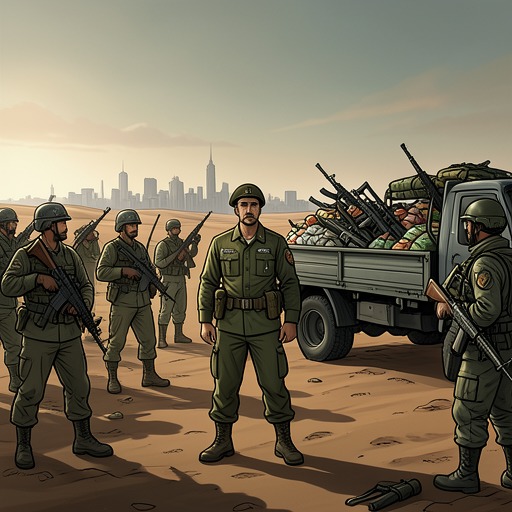
The same concentration of force appears in the operation at the San Pedro Harbor warehouses. Keller has heavily armed DEA agents, Federal Marshals, and Federal Bureau of Investigation personnel waiting for a specific warehouse location; because the harbor and its cargo facilities are extensive, the team cannot strike until the target is confirmed. When the entry begins, Keller leads agents through the office and opens the cargo door for another contingent of DEA, Federal Bureau of Investigation, and ATF personnel. The assembled force uncovers weapons intended for shipment to Colombia: two thousand Chinese-made AK-47s packed in pieces, two dozen handheld rocket launchers, and further truckloads of rifles and anti-vehicle weapons. Keller understands the rifles as part of a cocaine-for-arms exchange, with the weapons’ value measured in the drug cargo they could procure. The seizure turns intelligence about an international transaction into a coordinated enforcement action.
Intelligence, Informants, and Cartel Adaptation
The agency’s work also depends on information that cannot be obtained through raids alone. Nora Hayden secretly supplies Keller with intelligence for more than two years, leaving messages in dead drops around the city and eventually arranging to meet him in person. She gives him details of a meeting between Adán Barrera and Manuel and Gilberto Orejuela, enabling the DEA to arrest the brothers as they fly back to Colombia. She also reports on the Federación’s structure and provides hundreds of pieces of information about routes, safe houses, couriers, shipments, money movements, and killings. Keller uses those fragments to build an organizational picture of the Barrera organization in Baja California and California. Nora’s contribution makes her not merely a source for an isolated lead but a sustained intelligence channel into the cartel’s operations.
The agency’s pressure changes the structure of the market it is trying to police. Adán identifies the DEA’s dismantling of the Medellín Cartel and subsequent campaign against the Cali Drug Cartel as the cause of a gradual contraction in cocaine supply. After Fidel Cardona turns against his former friend Pablo Escobar and helps American agents track him down, the large Colombian organizations break into smaller groups that Adán calls the Baby Bells. The Orejuela brothers are arrested after returning from a meeting with Adán, further disrupting the established supply network. In Adán’s account, smaller cells are harder to monitor but less reliable: he must deal with many separate operators instead of a few large suppliers, and his expensive Boeing 727s can sit idle waiting for late, missing, or poor-quality cocaine. The campaign therefore inflicts real organizational damage, but also produces a fragmented trade whose instability travels from Colombian producers through wholesalers to retailers in American cities.
Corruption, Retaliation, and Consequences
The novel does not depict enforcement as a simple contest between incorruptible agents and traffickers. Adán describes bribes to Customs personnel, local police, state police, and sheriff’s departments, as well as payments to clerical employees who can disclose details of investigations and surveillance technology. At the San Ysidro and Otay Mesa crossings, cartel lookouts use radio contact and vantage points overlooking inspection lanes to steer shipments toward checkpoints they believe have been compromised. Even these precautions cannot guarantee passage: agents are reassigned, other personnel monitor radio bands, and the cartel expects some vehicles to be stopped. This account presents corruption as a networked vulnerability, but also distinguishes occasional access from the far more consequential difficulty of recruiting a DEA agent. Adán attributes that barrier to the continuing blood feud over Ernie Hidalgo’s killing and to Keller’s determination to sustain it.
For Keller, the case against Quito Fuentes shows how that feud becomes personal policy. Three American agents seize Quito, who argues that he cannot be arrested while in Mexico; Keller answers that the arrest will proceed. The agency’s pursuit of Doctor Álvarez is less immediately successful: he has a busy gynecology practice in Guadalajara, knows the DEA is aware of his role in Hidalgo’s murder, and refuses to approach the border. Keller’s investigations can reach into Mexico, but a target’s decision to stay put exposes the limits of that reach and the political friction generated by arrests there. Keller’s later surveillance of Miguel Ángel Barrera at 2718 Cosmos Street in Guadalajara likewise places agency action in a contest over sanctuary, surveillance, and the possibility that a fugitive might be protected from capture.
The DEA’s success also carries consequences for the people and institutions around it. Adán regards the agency’s pressure as commercially useful in one respect: by making smuggling more expensive and difficult, American enforcement helps sustain high prices for drugs that would otherwise be easier to transport. His reasoning does not erase the cartel networks disrupted by arrests or the losses imposed on their supply chains; instead, it exposes the market’s capacity to turn enforcement costs into part of the price of doing business. The agency can seize weapons, arrest traffickers, and deprive cartels of dependable suppliers, yet those actions do not by themselves dissolve the political and economic arrangements that allow the trade to adapt.
Narrative Significance
The U.S. Drug Enforcement Administration embodies the novel’s tension between institutional power and compromised purpose. Its coordinated task forces and international investigations can produce concrete results, from the arrest of the Orejuela brothers to the seizure of a major arms shipment. Its reliance on informants gives it access to cartel structures that surveillance and force alone cannot reveal. Yet the agency is also embedded in a political order where drug-war funding can facilitate anti-insurgent policy, where intelligence coordination is constrained by covert agendas, and where personal vengeance can shape the intensity of enforcement. Through the DEA, the campaign against trafficking appears neither powerless nor complete: it changes the organizations it targets, sometimes fractures them into harder-to-manage networks, and leaves unresolved the political bargains and incentives that keep the trade alive.